Sequential Logic#
Up until this point, all the circuits discussed have been combinatorial logic circuits, where the output of the circuit depends on its inputs but not on the current state of the output. However, we can feed the current output of a logic circuit back into the circuit as one of the inputs. Circuits with this feedback mechanism are called sequential logic circuits and form the basis of digital memory.
Two main types of sequential devices are latches and flip flops. We will delve into their differences soon, but both are represented similarly on a circuit diagram as a box with multiple inputs and exactly two outputs labelled \(Q\) and \(\bar{Q}\).
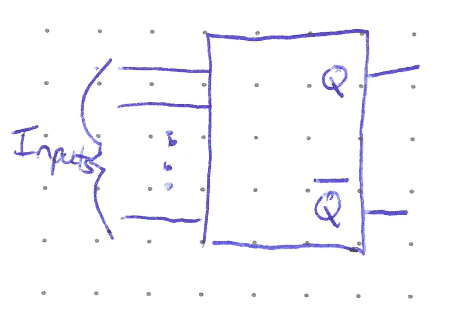
\(Q\) is the normal output. If ever just “the output” is mentioned in reference to a latch or flip flop, this is what is meant.
\(\bar{Q}\) is the inverted output. It always has the opposite value of \(Q\).
Thus there are two possible output states:
\(Q = 1\), \(\bar{Q} = 0\) - referred to as the High state or the SET state.
\(Q = 0\), \(\bar{Q} = 1\) - referred to as the Low state, CLEAR state, or the RESET state.