D Flip Flop#
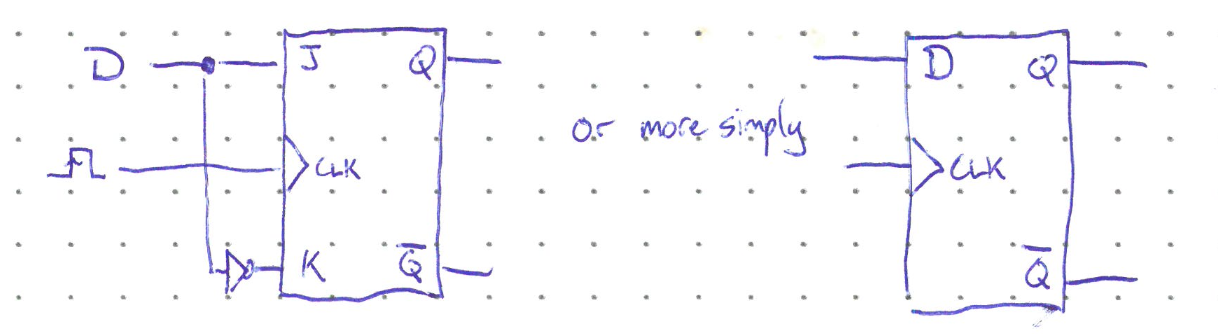
Unlike an SR or JK, a D flip flop has only one synchronous input, \(D\), which stands for data. The ouput \(Q\) will go to the same state as \(D\) on an active transition from the clock.
Concept Check:
If a D flip flop just passes the D value to Q, why have a flip flop at all? Why not just use a wire?
Solution
The clock is the important factor. A D flip flop will only change its output on an active clock transition. This ensures multiple components in a larger circuit can all work in lockstep with eachother.